Over 10 years ago, I worked at a school and in the classroom was this book that I really wanted to read but couldn’t find the time or patience. But now, more than 10 years later, and 6 years since I bought the book, I sat down to read it. The reason I waited so long was due to life events (job change, kids etc.) but also because the book itself seemed so daunting. 500 pages on history. Who in their right mind would read that?
But I did. And I read it in about 10 days (give or take). I don’t want to sound cliche, but I could not put it down. I literally stayed up to 2 AM reading when I had work the next day! This book, Guns, Germs, and Steel, by Jared Diamond, is a masterpiece in interdisciplinary humanities. Diamond easily moves from literature, culture, history, geography, economy, and politics throughout this book, tying together the entire history of the world in one comprehensive book that eliminates completely the false idea that some humans are better than others because of how they live.
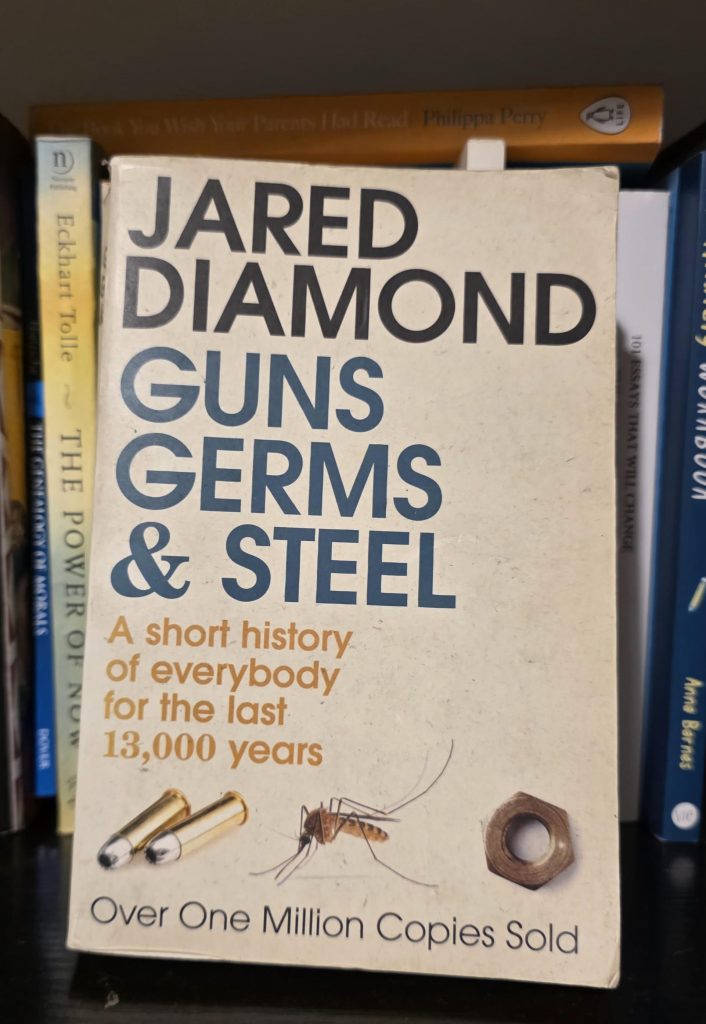
The book begins with a conversation Diamond had with a New Guinea man named Yali who asked him if we are all humans, how did the Europeans/Western humans conquer the world? (paraphrased). This started Diamond’s search for an answer. Through his own research, and some others, Diamond was able to piece together not just why different communities developed at different rates, but also why some communities chose not to develop in a certain way, why animals went extinct in some places but not in others, why languages seem similar or different across the world, why do some people have the same features but not belong together, and others with different features identify with the same group, the list goes on. But it was these big ideas that got me thinking, and then his specific examples that hooked me.
Diamond’s research, notes, evidence, and data as well as his method of writing really made me see history as a bigger and more important discipline than what I was teaching in schools. I wish I had read it earlier, from the moment I saw it abandoned in my old classroom, and utilized it to engage my students. It is robust, thorough, and illuminated some dark area in my mind about remote regions that aren’t commonly in the mainstream media, the islands in Oceania, and the tribes in East Africa. This book shifted my view of what it means to teach and understand GLOBAL history, and how it should be done, rather than memorizing facts and data from a more western perspective.
I know other books have done this as well (like the famous, Silk Roads – another on my TBR) but this book is older, published in the 60s, and really a one-man research based on real people, with their photos, published data in the form of maps, charts, and tables. It was truly a joy to read, and I cannot express my love for history and all that ways that it can be used, and especially after reading this fantastic book.
If you are interested in history, and understanding how the world got to the place it got to today I really encourage finding and reading this book. It was a riveting read, and very elaborate I couldn’t find fault in any part of it. Highly recommended, and deeply profound.


Leave a Reply